NFL Films Taught Us How To Watch Football

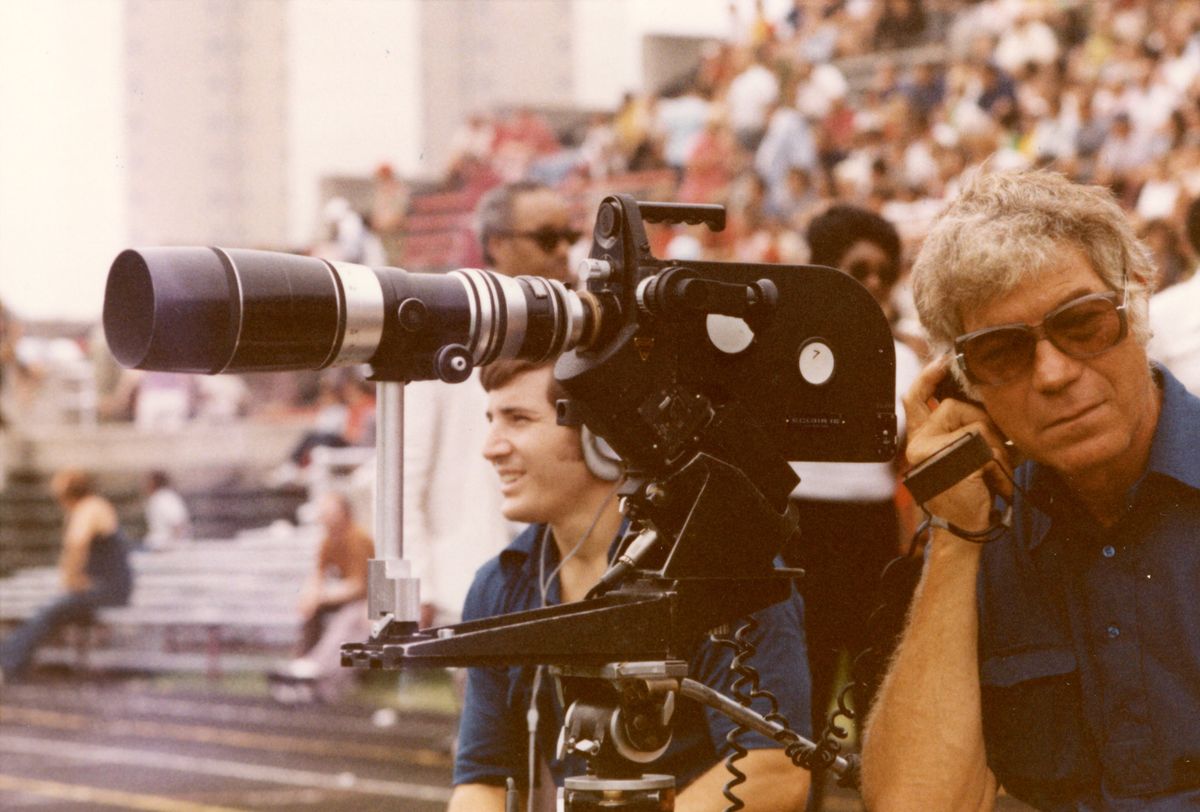
When Steve went to work full-time at NFL Films in 1964, he arrived with a sense of mission. Ed had sketched the outline; Steve would jam it full of color, character, incident. The game had always been seen from a distance: the backsides of the linemen in three-point stance, the pile of bodies. Steve wanted to open the game like a sandwich, peer inside, show people things they'd never been able to see. He would take them onto the field, into the locker rooms—even into the huddle, the most sacred place in pro sports.
Steve began experimenting in the mid-1960s, pioneering techniques that still define sports coverage, documentary film, even reality TV. He was the first to mic a coach, the first to use pop music in sports films, the first to diagram a play onscreen. He put cameras everywhere. He kept filming the QB after he had thrown the ball and was tackled, showing fans what it's like when the wall of pain arrives.
Steve hired former NFL players to work the cameras, because they could better anticipate where the play was going. "I remember watching the camerawork, saying to myself, How do those guys do that?" said Hank McElwee, a cameraman and the director of photography at NFL Films. "They were getting angles you had never seen. On TV, you'd always see the shot from the main camera, which sits high above the stadium—never any handhelds. And here was this little company doing slow motion, doing sound. They were on the field. I remember saying 'Boy, that really makes you feel like you're part of the game.' "
There's a degree of Heisenberg's uncertainty principle in all this: by observing the game, the Sabols changed it. Their movies taught a generation of kids who became players how to behave onscreen. It made them self-conscious. "I remember the first player who looked into the lens and said 'Hi, Mom.' I thought it was the end of everything," Steve told me. " 'We can't capture it anymore. The players are thinking about us as much as we're thinking about them.' But I was wrong. In the end, the performance became another part of the game." If you want to understand football, don't look at Jim Brown or John Elway or Tom Brady, Steve explained. Look at Homer Jones, a receiver for the Giants in the 1960s. Players used to hand the ball to the referee after scoring, or toss it to the fans. Jones, wanting to distinguish himself, whipped it into the turf instead. The first spike. You can go from there to Billy "White Shoes" Johnson's end-zone dance, Ickey Woods's shuffle, Terrell Owens's Sharpie, Rob Gronkowski's antics. In the modern game, the camera is the 12th man, another participant in the unfolding drama.
The 5-0 49ers Are Finally Getting the Respect They Deserve
Jorge Masvidal Makes $100K Pick to Beat Islam Makhachev
Dana White's Contender Series Week 10 Predictions and Picks
Guardians vs. Rays Prediction: Picks, Odds for ALCS Game 1
- Three Longshot NFL Futures Worth Betting in Week 5
- Falcons vs. Ravens Odds, Prediction and Best Bet for Sunday Night Football
- White Sox vs. Guardians ALDS Game 5 Betting Pick
- UFC Vegas 122 Betting Odds: The Biggest Line Moves Before Allen vs. Duncan
- UFC Vegas 122 Picks and Predictions: Three Bets for Allen vs. Duncan
- College Football Week 6 Bets: Three Picks for Saturday’s Biggest Games
- UFC Fight Night Underdog Pick: Why Kai Kamaka III Is Worth a Bet