Surprise: Being Poor Makes It Much Harder To Get To The NBA

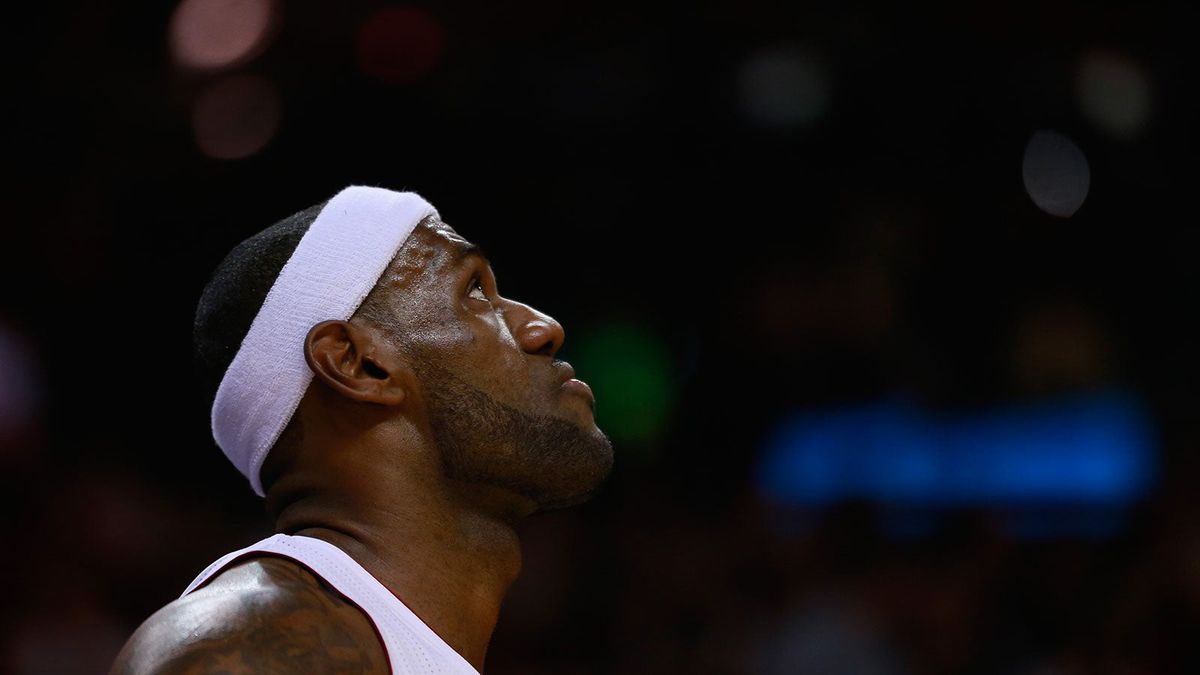
Here's something that would be roundly unsurprising in most any other context, but will still startle many: Where you grow up, and how wealthy your family is, has a profound effect on the odds you'll make it to the NBA.
There's a basic profile of what a typical NBA player's life was like before he made it to the league that a lot of people carry around in their heads. It runs something like the LeBron James story, involving a black kid from a broken home using basketball as a way out of poverty. And sometimes that bears out. But over at the , Seth Stephens-Davidowitz used a combination of US Census data, birth records from the CDC, and basketball-reference.com data to calculate the probability getting to the NBA from every county in the United States. The results were antithetical to the standard Biggie Smalls line of thought.
Growing up in a wealthy neighborhood is a "major, positive predictor" for playing in the NBA, even accounting for kids of former players. Black NBA players are an estimated 30 percent less likely to be born to either an unmarried or teenage mother, and they are 50 percent less likely to have a "distinctively black" name— this has been found to be a strong indicator for low-income black families, but the research doesn't show it has any effect on later life outcomes. (To be clear: we're talking about broad population effects, not individual families.)
From 1960 to 1990, nearly half of blacks were born to unmarried parents. I would estimate that during this period roughly twice as many black N.B.A. players were born to married parents as unmarried parents. In other words, for every LeBron James, there was a Michael Jordan, born to a middle-class, two-parent family in Brooklyn, and a Chris Paul, the second son of middle-class parents in Lewisville, N.C., who joined Mr. Paul on an episode of "Family Feud" in 2011.
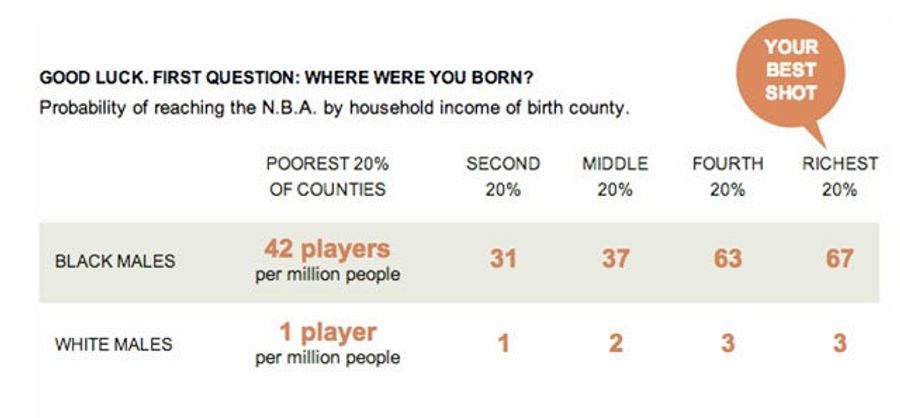
Stephens-Davidowitz cites two main reasons this happens. The first is a basic overturning of the tired "poor players are hungrier" idea. Family wealth is often associated with both IQ and scholastic achievement, and that's believed to be due in part to richer kids getting a leg up in "noncognitive skills like persistence, self-regulation and trust," and their ability to maximize their talent productively.
Perhaps more important, though, is that less well-off kids are actually, physically hungrier. Proper eating is vital to a child growing as tall as his or her genetics will allow— around 20-40 percent of the difference in height between people can be attributed to environmental factors, with nutrition being most important—and height is the most precious trait in the NBA. By Stephens-Davodowitz's estimation, every inch a player grows basically doubles his chances of making the NBA. Further context makes that even more striking. By Sports Illustrated's count, also using data from the CDC, the number of 7-foot men aged 20-40 in the NBA represents about 17 percent of all such men in the country. Seventeen percent! If you're seven feet tall, you have a better than one in six chance to make it in the league, and you have a better chance of growing that tall if you're from a well-off, stable family.
You should check out the rest of the piece at the Times. There is, in particular, a lot more context about how height discrepancies affect international players. (Poorer countries are shorter, but growing.) There's room to dig further here in the future, as well. Does the wealth gap persist from backcourt players to bigs, whose height is more important? Does the idea that low-income kids with limited noncognitive skills (self-control, persistence, etc.) check out with data like suspensions or technical fouls or other types of outbursts? Or high draft picks flaming out? It's a fascinating topic, and one we're going to (hopefully) be asking Seth about in the next few days.
[ New York Times, 2]
Related


The 5-0 49ers Are Finally Getting the Respect They Deserve
Jorge Masvidal Makes $100K Pick to Beat Islam Makhachev

Dana White's Contender Series Week 10 Predictions and Picks


Guardians vs. Rays Prediction: Picks, Odds for ALCS Game 1



- Three Longshot NFL Futures Worth Betting in Week 5
- Falcons vs. Ravens Odds, Prediction and Best Bet for Sunday Night Football
- White Sox vs. Guardians ALDS Game 5 Betting Pick
- UFC Vegas 122 Betting Odds: The Biggest Line Moves Before Allen vs. Duncan
- UFC Vegas 122 Picks and Predictions: Three Bets for Allen vs. Duncan
- College Football Week 6 Bets: Three Picks for Saturday’s Biggest Games
- UFC Fight Night Underdog Pick: Why Kai Kamaka III Is Worth a Bet