Syracuse's Concussion Protocol Seems, Uhh, Inadequate?

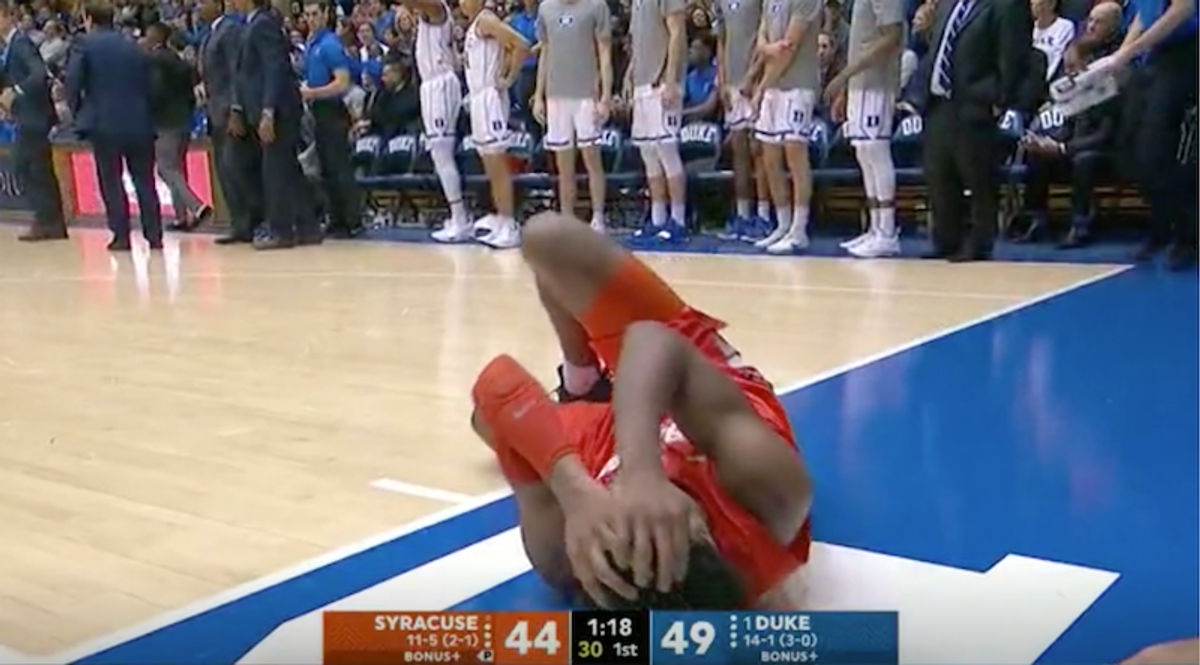 source: ESPN
 Late in the first half of Syracuse’s big road win over Duke Monday night, junior forward Elijah Hughes drove left against Marques Bolden and threw up a no-hope layup over a soaring Zion Williamson contest. His own momentum plus the combined push of Bolden and Williamson threw Hughes off balance, and he came down hard on his back and smashed his head into the floor.
Several things are striking about this. Play resumed for another seven or eight seconds—long enough for a Duke transition try the other direction—with Hughes grabbing his head and writhing on the baseline, unattended. When play finally did stop, on a whistle for a foul at the other end, one person in the arena made an effort to check on Hughes, and it appeared to be a Syracuse assistant or trainer, who made his way to Hughes at what could be described as a leisurely saunter.
But perhaps nothing about it is as alarming as this: Not only was Hughes not put through any kind of comprehensive concussion protocol, he wasn’t even removed from the game. Following the timeout—during which Hughes was helped to his feet and guided back to Syracuse’s bench—he was back on the floor, without even a commercial break’s worth of evaluation or treatment. A little over a minute later he hit an 80-foot buzzer-beater, and he finished the night having played a game-high 45 minutes.
It would be hard to tell from this video, but Syracuse does, in fact, have a concussion policy for student-athletes. It calls for a fairly comprehensive concussion evaluation by the staff and a physician, but only mandates that the evaluation be given within 24 hours of a suspected concussion. Presumably Hughes will undergo such an evaluation—should he show symptoms of a brain injury, he will be held out for at least the mandated, uhh, one calendar day of activity set forth in the policy. Nowhere anywhere under the heading “Assessment and Evaluation Following Head Trauma” are conditions described for removing a player from a game for the purposes of evaluation; the “Return-To-Play Protocol” is concerned entirely with the process of returning a player to action after he or she has already been diagnosed with a concussion.
The closest the policy comes to addressing what happened to Hughes tonight is describing the symptoms Syracuse identifies with concussions, and mandating the presence of a “medical team physician with training in diagnosis, treatment and initial management of acute concussions” at all varsity competitions. Whatever the protocol, the fact that Hughes smashed his head on the floor, stayed on the ground through the following sequence, and then needed to be helped to his feet should tell anyone watching that he at least needed a more serious evaluation for brain injury than whatever quiet conversation took place in the seconds following his fall. But never mind! Hughes hit a big highlight shot, and the Orange won, so I guess everything is hunky-dory.
Guardians vs. White Sox Game 4 Bet Picks, Prop Bets

The Yankees’ 17-Year Title Drought Is on Hal Steinbrenner
Luke Fickell Has Wisconsin Football Rolling Again
Buccaneers vs. Cowboys Odds, Prediction and Best Bet for TNF
The Biggest Disappointments of the MLB Playoffs So Far
Three Non-Power College Football Playoff Contenders
Why Doesn’t the NFL Have Full-Time Referees?
- WNBA Playoff Bet Picks: Aces, Valkyries, Liberty and Dream Predictions
- MLB Playoff Picks for Wednesday: HR Props, ML Picks and More
- Milwaukee Brewers vs. San Diego Padres Game 3 Bet Picks and Predictions
- Dana White’s Contender Series Week 9 Predictions: Picks for Every Fight
- Two MLB Playoff Bets Stand Out on Monday
- Yankees vs. Rays Prediction: Best Bets for ALDS Game 2
- Falcons vs. Saints Prediction: Best Bet for Monday Night Football