The New York Times Has A Five-Point Plan For Fixing College Sports

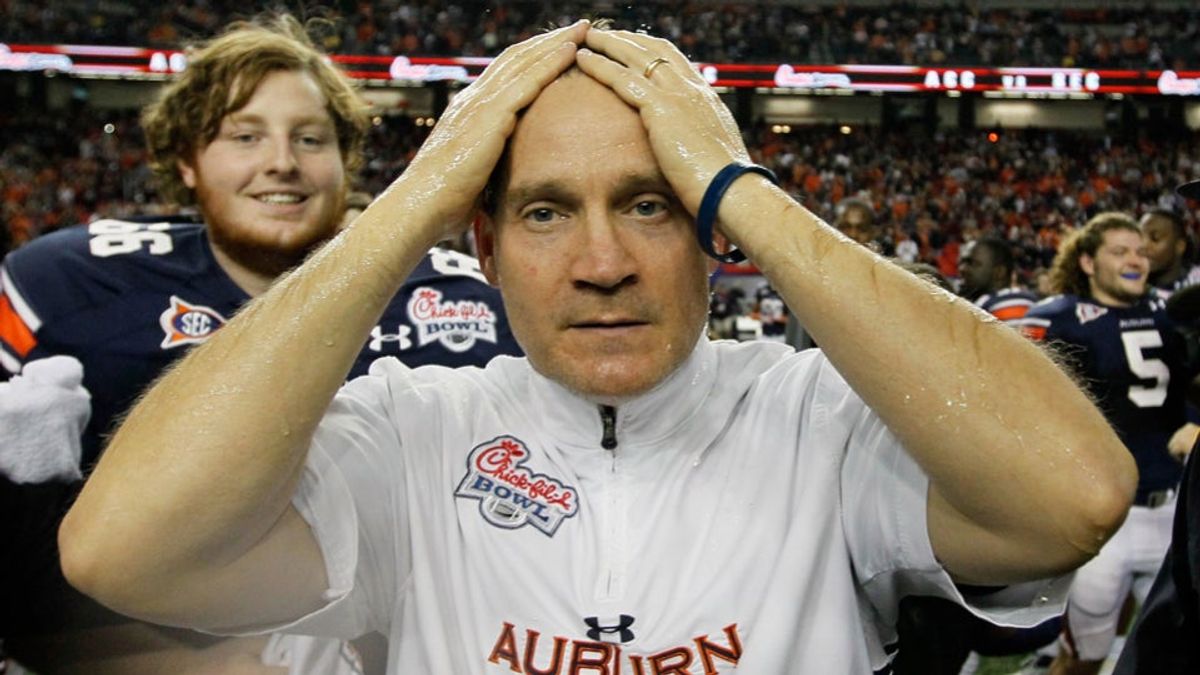
Here's Joe Nocera, writing in The New York Times Magazine this weekend:
There are five elements to my plan. The first is a modified free-market approach to recruiting college players. Instead of sweet-talking recruits, college coaches will instead offer athletes real contracts, just as professional teams do. One school might think a star halfback is worth $40,000 a year; another might think he's worth $60,000. When the player chooses a school, money will inevitably be part of the equation. For both coaches and players, sweet-talking will take a back seat to clear-eyed financial calculations.
The second element is a salary cap for every team, along with a minimum annual salary for every scholarship athlete. The salary caps I have in mind are pretty low, all things considered: $3 million for the salaries for the football team, and $650,000 for basketball, with a minimum salary of $25,000 per athlete. I would keep the number of basketball scholarships the same, at 13, while reducing the number of football scholarships from 85 to a more reasonable 60, close to the size of N.F.L. rosters. Thus, each football team would spend $1.5 million on the minimum salaries, and have the rest to attract star players. Basketball teams would use $325,000 on minimum salaries, and have another $325,000 to allocate as they wish among players. Every player who stays in school for four years would also get an additional two-year scholarship, which he could use either to complete his bachelor's or get a master's degree. That's the third element.
The fourth: Each player would have lifetime health insurance. And the fifth: An organization would be created to represent both current and former college athletes.
Dig it.
There's also a bit at the beginning where he talks to NCAA president Mark Emmert, and it's always a treat when journalists talk to Emmert, because his organization and its principles are completely indefensible. Yet he tries to defend them anyway:
He visibly stiffened. "If we move toward a pay-for-play model—if we were to convert our student athletes to employees of the university—that would be the death of college athletics," Emmert retorted. "Then they are subcontractors. Why would you even want them to be students? Why would you care about their graduation rates? Why would you care about their behavior?"
Mark Emmert cares. Don't you?
Let's Start Paying College Athletes [NYT Mag]
Related
Why the Milwaukee Brewers Are Built to Win the World Series



The Most Shocking WWE Moments Fans Never Saw Coming




- Cowboys vs. Packers Prediction: Best Bet for Sunday Night Football
- UFC Edmonton Best Bets, Predictions and Fight Picks
- Rays vs. Guardians Game 4 Best Player Props Betting Picks
- College Football Week 8 Best Bets: Ohio State, Alabama and More
- Joaquin Buckley Plummets From -300 Favorite to Underdog at UFC Edmonton
- WNBA Finals Picks: Dream, Valkyries and Gabby Williams Best Bets
- UFC Vegas 122: 5 Underdogs Drawing Sharp Money This Weekend