Why Don't We Let Injured Athletes Use PEDs?

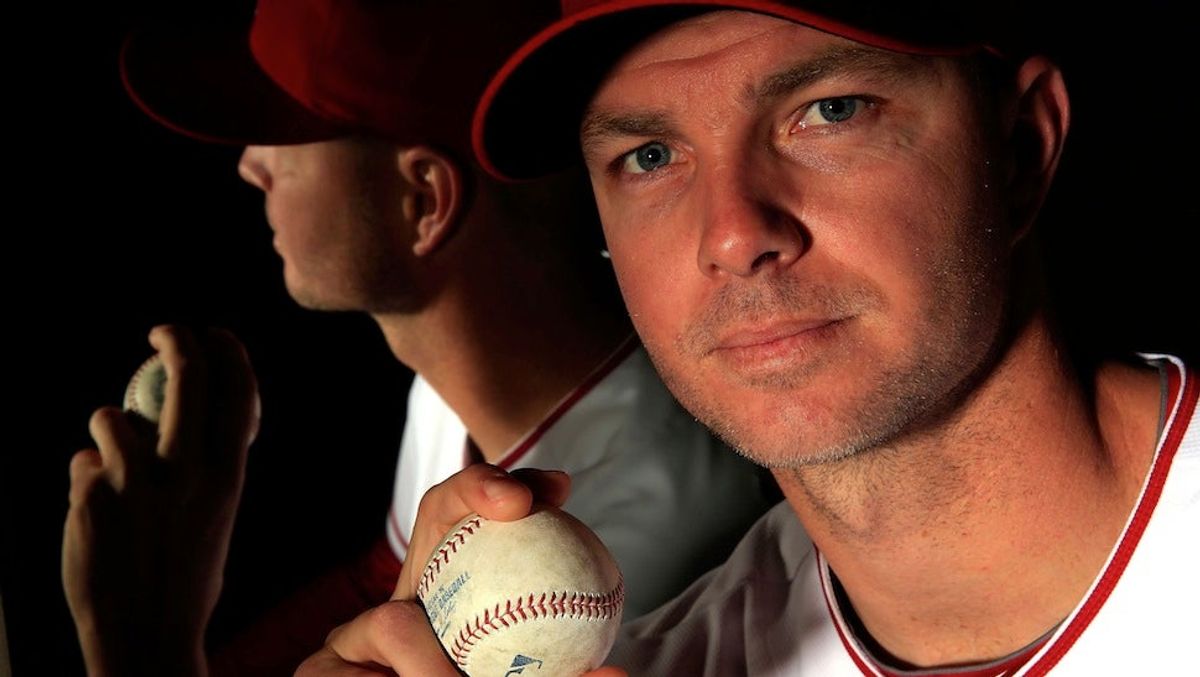
Reliever Ryan Madson missed all of 2012 after Tommy John surgery, but signed with the Angels expecting to be healthy to begin the season. It hasn't happened, and he doesn't seem much closer. So he wonders, "If HGH were legal..."
Madson is 14 months removed from surgery—"I can't believe it's taken this long," he said after yet another setback—but can't throw without pain. He's tried altering his workout routine, he's gone to four different orthopedists, and he still can't do anything but soft toss without crippling soreness the next morning. He's desperate, and at 32 years old, likely questioning if he'll ever make it back.
But what if science held an answer, or at least hope? What if a series of injections to could build up the muscle in his arm, make his surgically repaired ligament stronger and stretchier, and give him another chance playing baseball. Even if it's not guaranteed to work, wouldn't it be worth a shot? Madson thinks so. In an interview with MLB.com, he questions the arbitrary line between "PED" and "medicine."
"If HGH were legal," Madson said, "just in the process of healing, under a doctor's recommendation, in the right dosage, while you're on the [disabled list], I don't think that's such a bad idea — as long as it doesn't have any lasting side effects, negative side effects.
"But I will still believe, even if I get healthy without that, that it should be legal, in the right dosage, under supervision, with doctors, for the only purposes to help heal and get players back in the Major Leagues. Because people want to watch them, because of their talents, just to get them back on the field to play. That's it. I think it would be good for the game; I think it would be good for the fans. Fans want to see the best players play, and they want to see the players that they watch come back from injury and stay back. I think it would be a good thing."
The science is far from cut-and-dried. There have been remarkably few large-scale studies on the short- and long-term effects of HGH usage. It is prescribed by doctors, though rarely, and nearly always for medical conditions that specifically result in and from a natural growth hormone deficiency. (Lionel Messi, diagnosed with GHD, received HGH treatment beginning at age 11, paid for by Barcelona.)
This much is certain: in GHD patients, HGH builds muscle mass, increases bone density, strengthens connective tissue, makes circulation more efficient, improves cell division, and speeds recovery time and resistance to injury. (Whether these same effects occur in otherwise healthy patients is the subject of very heated debate.)
Madson, with his career window closing and millions of dollars on the line, is willing to give it a try. That's understandable, and more than a little brave knowing his statements are going to ruffle some feathers on Park Avenue, where they'd like to pretend that every PED (an arbitrary, damning name that doesn't exist outside the sports world) doesn't have legitimate medial uses. If Madson's argument has a flaw, it's where he draws the line:
"Not steroids," he said. "Not steroids. No."
Both HGH and steroids are organic compounds, reproducing hormones naturally found in the human body; HGH is identical to somatotropin, while anabolic steroids mimic testosterone. Each has similar recuperative effects on bones, muscles, ligaments, blood cells. But while anabolic steroids are just as verboten in baseball as HGH, they are exponentially more accepted in medical science—steroids are widely prescribed for ailments ranging from anemia and bone loss to cancer and AIDS. Doctors have a very clear understanding of appropriate doses, and under an observed and regulated regimen, side effects can be closely controlled. Steroid abuse is dangerous; steroid treatment is safe and commonplace.
If Ryan Madson were allowed to use steroids, he'd have a better chance of playing Major League Baseball again, and a low chance of suffering adverse effects. He can't, because of that arbitrary line. How arbitrary? There's a commercially produced steroid, though non-Anabolic, that when injected reduces pain and inflammation in an injured joint, and allows an athlete to play when they otherwise wouldn't be able. It sounds like magic, but it's just biochemistry. It's called cortisone, it's used by baseball players throughout the season, and it's completely and totally legal in MLB.


Most of the Hands on This Poker Site Were Played by Bots
Guardians vs. Rays ALCS Game 6 Best Betting Picks


Rays vs. Guardians Game 5 Predictions: Best Bets for ALCS
- Cowboys vs. Packers Prediction: Best Bet for Sunday Night Football
- UFC Edmonton Best Bets, Predictions and Fight Picks
- Rays vs. Guardians Game 4 Best Player Props Betting Picks
- College Football Week 8 Best Bets: Ohio State, Alabama and More
- Joaquin Buckley Plummets From -300 Favorite to Underdog at UFC Edmonton
- WNBA Finals Picks: Dream, Valkyries and Gabby Williams Best Bets
- UFC Vegas 122: 5 Underdogs Drawing Sharp Money This Weekend