Gentling Cheatgrass

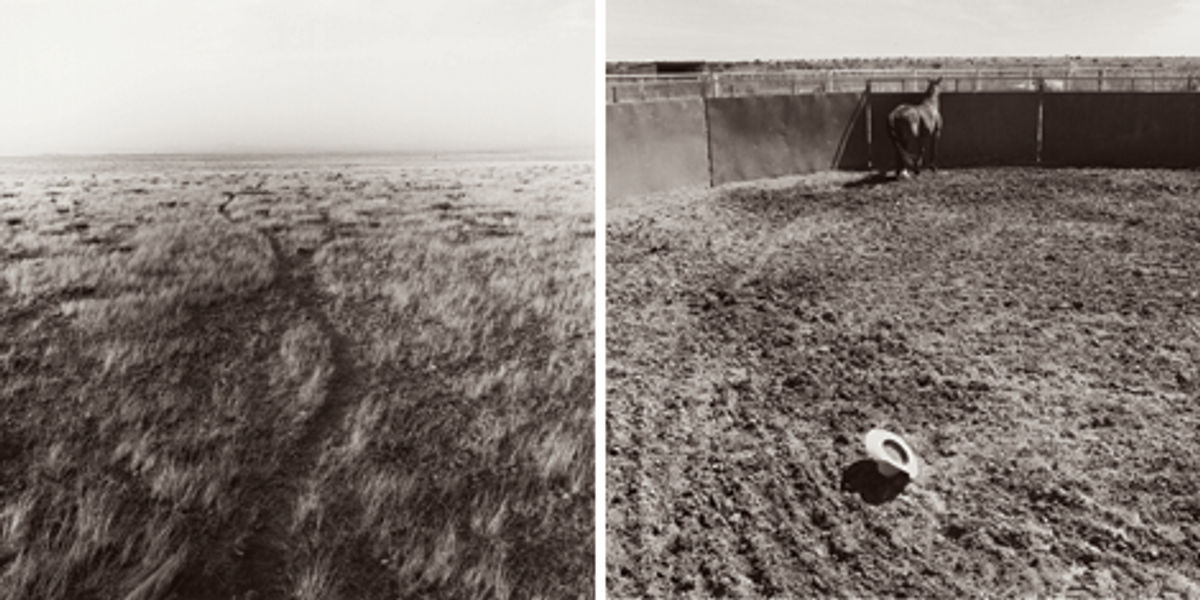
Dig— Sterry Butcher's 2010 :
The Mustang has eyes that are large and dark and betray his mood. His coat is bright bay, which is to say he’s a rich red, with black running down his knees and hocks. He has a white star the size of a silver dollar on his forehead and a freeze mark on his neck. He cranks his head high as a rider approaches, shaking out a rope from a large gray gelding. The mustang does not know what is to come. His name is Cheatgrass, and he’s six years old. In May he was as wild as a songbird.
The little horse belongs to Teryn Lee Muench, a 27-year-old son of the Big Bend who grew up in Brewster and Presidio counties. Teryn Lee is tall, blue-eyed, and long-limbed. He wears his shirts buttoned all the way to the neck and custom spurs that bear his name. He never rolls up his sleeves. A turkey feather is jammed in his hatband, and he’s prone to saying things like “I was out yesterday and it came a downpour,” or, speaking of a hardheaded horse, “He’s a sorry, counterfeit son of a gun.” Horse training is the only job he has ever had.
Teryn Lee was among 130 people who signed up this spring for the Supreme Extreme Mustang Makeover, a contest in which trainers are given one hundred days to take feral horses from the Bureau of Land Management (BLM), gentle these creatures, and teach them to accept grooming, leading, saddling, and riding. Don’t let the silliness of the contest’s name distract from the difficulty of the challenge. Domestic horses can be taught to walk, trot, and lope under saddle in one hundred days; it’s called being green-broke. But domestic horses are usually familiar with people. The mustangs in the Makeover have lived on the range for years without human interaction, surviving drought, brutal winters, and trolling mountain lions. The only connection they have to people is fear. Age presents another challenge. A domestic horse is broke to saddle at about age two, when it’s a gawky teenager. The contest mustangs are opinionated and mature. The culmination of the contest is a two-day event in Fort Worth in August, where the horses are judged on their level of training and responsiveness. The top twenty teams make the finals. The winner takes home $50,000.
For Teryn Lee, however, there’s more at stake than money. Most of his clients bring him horses that buck or bully, horses that have developed bad habits that stymie or even frighten their owners. Teryn Lee enjoys this work, but his goal is to become a well-known trainer and clinician who rides in top reined cow horse and cutting horse competitions. To step up to that level, he’ll have to do something dramatic. Transforming a scruffy, feral mustang that no one wanted into a handsome, gentle, willing riding horse would make people take notice. Winning would get his name out there, he says.
[Photo Credit: James Evans]


The 5-0 49ers Are Finally Getting the Respect They Deserve
Jorge Masvidal Makes $100K Pick to Beat Islam Makhachev
Dana White's Contender Series Week 10 Predictions and Picks



Guardians vs. Rays Prediction: Picks, Odds for ALCS Game 1



- Three Longshot NFL Futures Worth Betting in Week 5
- Falcons vs. Ravens Odds, Prediction and Best Bet for Sunday Night Football
- White Sox vs. Guardians ALDS Game 5 Betting Pick
- UFC Vegas 122 Betting Odds: The Biggest Line Moves Before Allen vs. Duncan
- UFC Vegas 122 Picks and Predictions: Three Bets for Allen vs. Duncan
- College Football Week 6 Bets: Three Picks for Saturday’s Biggest Games
- UFC Fight Night Underdog Pick: Why Kai Kamaka III Is Worth a Bet