MLB Announces Revolutionary New Fielding-Tracking System

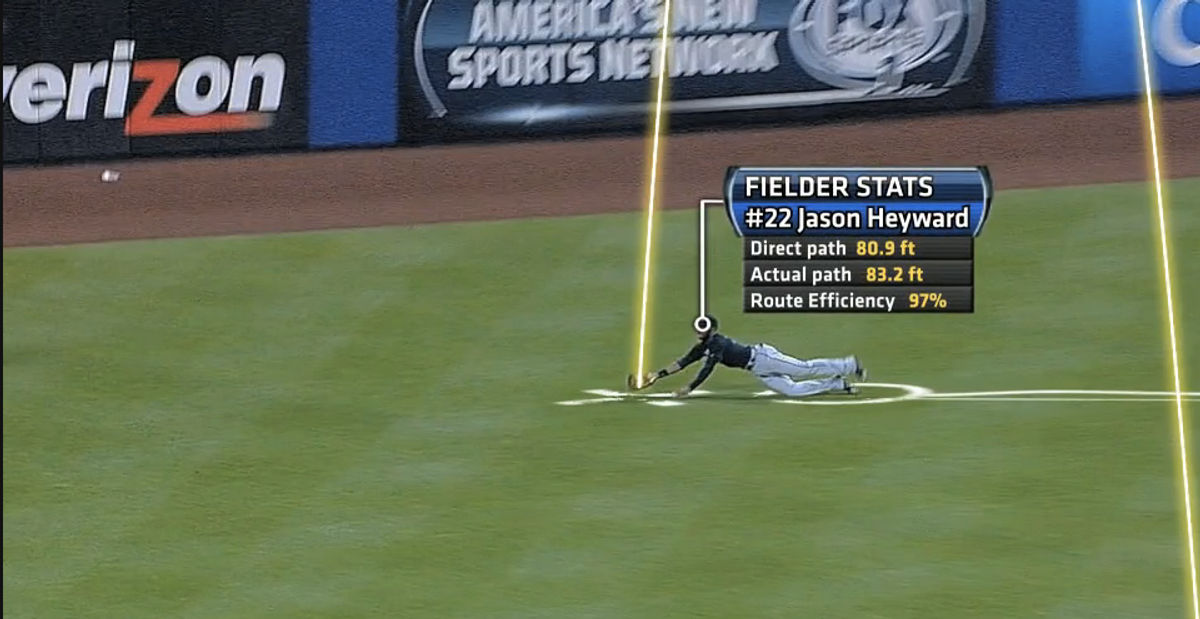
Even in their recent state of repair, defensive metrics have always had a certain reverse-engineered, SABR-in-retrograde quality to them, even in a statistically mature sport like baseball. MLB Advanced Media just announced a new system that would slam the door shut on that era.
At the MIT Sloan Sports Analytics, MLBAM announced a new tracking system (there isn't even an official name for it yet), similar to the SportVU cameras that the NBA has installed and totally separate from FIELDf/x. It tracks the speed and efficiency of fielders, based on highly accurate readings on hit balls—batted ball speed, launch angle, distance, hang time—and then how fast and how well the defenders react, capturing 30 frames per second on players and 2000 fps on the ball. It's the Holy Grail, basically.
The cameras went through a pilot test last year at Citi Field, and track the trajectory and speed of a ball, and show the path it takes. Simultaneously, they recognize where defenders are on the field, and how far they are from where the ball will land; it then tracks their actual paths, and how optimal they were. One of the examples used was a fly ball hit to left-center: Jason Heyward tracked it and caught it, running at a top speed of over 18 miles per hour, accelerating at 15.1 feet per second, and taking a path that took 83.2 feet, compared to the 80.9-foot optimal path. This is a 97 percent-efficient path, and was far faster than that of the left fielder, whose stats we also see. (Also tracked: reaction time, which is both useful and cool.) This will happen for every single ball put into play.
For now, the plan is for the cameras to be in three ballparks this year—Miller Park in Milwaukee, Target Field in Minnesota, and a second season at Citi Field—and every park in the league by 2015. Like PITCHf/x, it will be made available in near-realtime for broadcast and highlights.
The obvious question is how public the data will be, and MLBAM doesn't have definitive answers just yet. That can be read as the cookie jar slamming shut on this fantastic data, due to teams hoarding it so they can run proprietary evaluations for themselves. In actuality, it's more like the league not wanting to get ahead of itself. It will likely take a similar rollout to PITCHf/x, which made its way into the public domain back in 2006. Among concerns about how to make this stuff public, the issue of the sheer scale of the data has already cropped up. This will likely be a massive amount of data and take a massive amount of computational power to sort through—the SportVU data, for example, is incredibly heavy—so just the delivery mechanism could be a bottleneck, like you see with 4k TV content.
Still, just look at that video. This is phenomenal. Want to know what your shortstop's range was, and how many balls he missed to the right? The data exist now, in impeccable detail.
Update: Commenter
notes that a presenter said the system is generating seven terabytes of data per game. That's a lot, and raises questions about how independent researchers would even handle it, though presumably MLBAM is working on a way to put out stripped-down but still useful datasets.
Related





Seattle Seahawks vs. Denver Broncos TNF Betting Pick




Los Angeles Chargers Shouldn’t Resist Justin Herbert Trade
- Guardians vs. Rays Game 2 Prediction: Picks, Odds and Best Bets
- Bills vs. Rams Odds, Prediction and Best Bet for MNF
- Three Longshot NFL Futures Worth Betting in Week 5
- Falcons vs. Ravens Odds, Prediction and Best Bet for Sunday Night Football
- White Sox vs. Guardians ALDS Game 5 Betting Pick
- UFC Vegas 122 Betting Odds: The Biggest Line Moves Before Allen vs. Duncan
- UFC Vegas 122 Picks and Predictions: Three Bets for Allen vs. Duncan