The Evolution Of The Halfpipe: Faster, Higher, Safer?

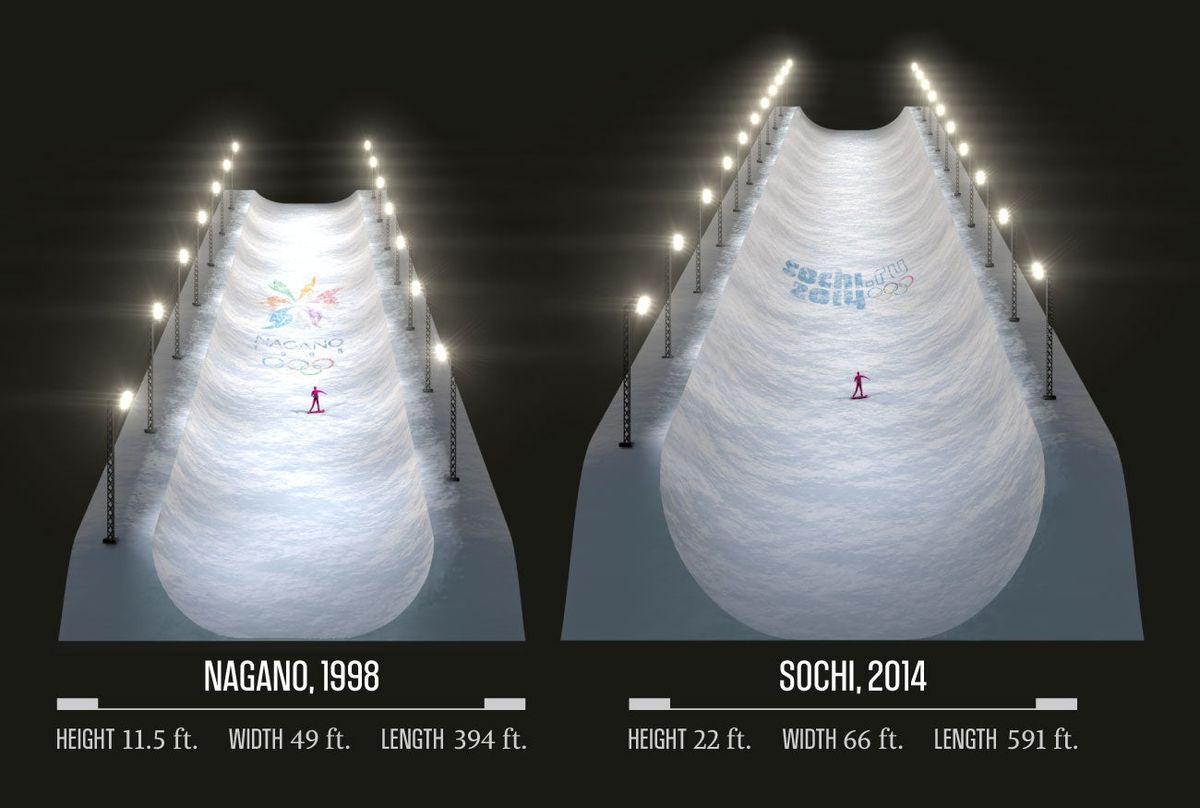
The men's halfpipe final was sort of a disaster today, as a terribly maintained Sochi course led to falls (or at least slips) for most of the major competitors. But, hey, no one got hurt!
Over on Co.Design, Gus Wezerek and Mark Wilson have a great piece on how the modern design of the snowboard halfpipe—now generally know as the "superpipe"—may actually be making the sport safer, even as it gives competitors chances to reach faster speeds and catch bigger air.
The key is the slope from the floors to the walls. As you can see from the chart above, Sochi's superpipe is a lot bigger, and a lot curvier, than the version introduced at Nagano in 1998, which was essentially a skateboard halfpipe made out of snow. The flat bottom of the pipe wasn't an issue on a skateboard, but it wreaked havoc on snowboarders' knees as they hit the curve:
Each transition was essentially an impact—energy that would compress into the rider's knees like a loaded spring. By the time a rider would reach the top of the transition, he would have a very difficult time containing that energy. Many boarders would spring their knees out from an 85-degree angle, then fall back on the snow floor in the middle of the halfpipe.
"That's how I tore my ACL," [U.S. Snowboarding Halfpipe Coach Rick] Bower tells us. "We all blew our knees out on those things, because it was jarring and quick, and I'd say more dangerous.
The Olympic halfpipe has expanded in every dimension since Nagano, but the walls have almost doubled in height, while the width has increased by only 35 percent. This means that more of the width has to be given over to the sloping sections of the walls, and the knee-dicing "transitions" impacts have essentially disappeared: Once you're done coming down from one wall, you're already gently heading up the other.
Of course, this extra height (and the extra distance of the track) also gives the riders a lot more speed to try crazier tricks. This is the curse of extreme sports, which are designed to reward those who push the already ridiculous limits of their events, to flip three times when everyone else flips twice. For superpipe competitors, the danger of serious injuries—like ACL tears—may be lower than even before. The risk of catastrophic injuries—like Luke Mintrani's broken neck—may be higher than ever.
[ Co.Design]

WNBA Picks Today: Caitlin Clark, Dream and A’ja Wilson Props

MLB Picks Today: Two Best Bets for Thursday, August 20






3 Most Overrated Teams in the AP Top 25 Preseason Poll
- Dodgers vs. Rockies Prediction: Best Bets for Tuesday’s MLB Game
- WNBA Picks Today: Best Bets for Tuesday, August 18
- Tigers vs. Pirates Prediction: Best Bets, Odds and Picks for Monday
- MLB Best Bets: 3 Picks to Target on Sunday’s Full Slate
- MLB Betting Picks Today: Two Best Bets for Saturday, August 15
- UFC 330 Betting Guide: Best Bets for Makhachev vs. Machado Garry
- UFC 330 Picks: Top Plus-Money Underdog Prediction