The Genius Of Enemy Of The State, Tony Scott's Best Film

In the reaction to the sudden death of Tony Scott, a quick consensus emerged: Scott was a more interesting director than he'd been given credit for throughout his career; Top Gun and his general style helped usher in the age of Michael Bay and Olivier Megaton-ism; and the one movie everyone could agree had Legitimate Critical Value was True Romance.
And I love True Romance as much as anybody does. It's one of those appreciated-much-more-two-decades-later films, largely because it's remembered as a Quentin Tarantino-by-association project. (Funny how Natural Born Killers is now just an Oliver Stone joint, and everyone has decided to forget the let's-all-indulge-Tarantino-and-pretend-he-can-act period.)
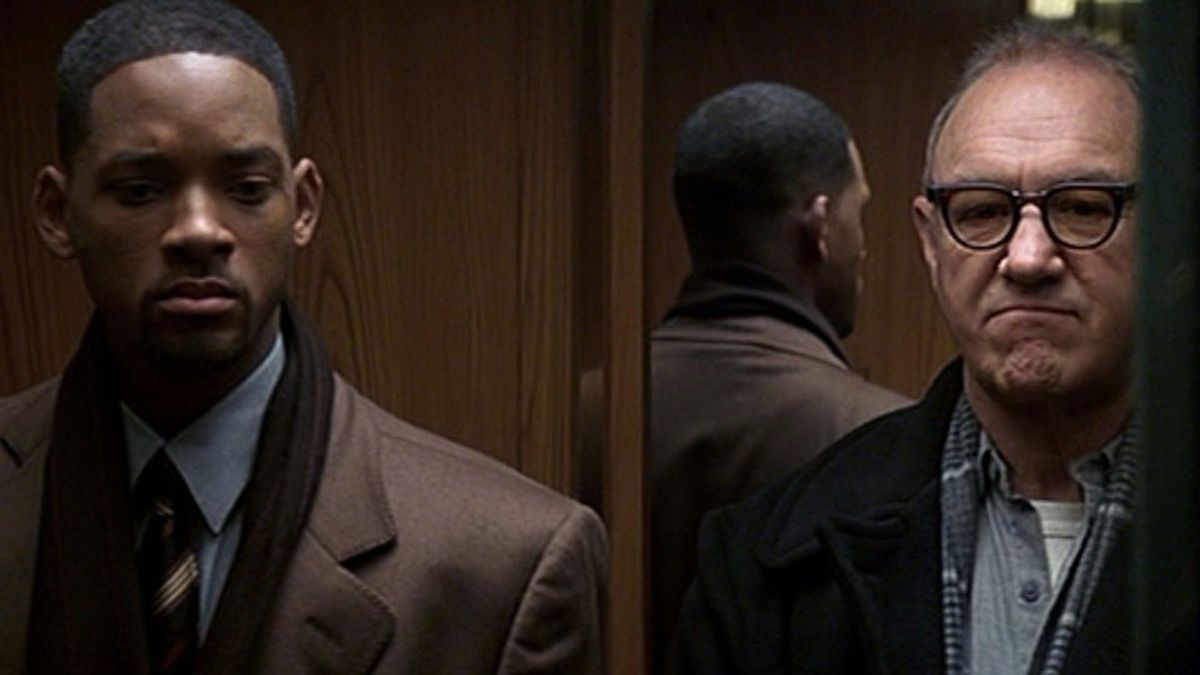
But for my money, the great Tony Scott film is Enemy of the State: a huge Hollywood hit, a scathing (and prescient) critique of government's prying into the lives of their citizens, and, oh, by the way, a story featuring one of the most iconic characters in American cinematic history.
That would be Edward Lyle, played by Gene Hackman in what is clearly, deliberately meant to be a version of his notorious Harry Caul of Francis Ford Coppola's 1974 film The Conversation, one of my favorite movies of all time. It's very possible that Scott meant this to literally be the same character; someone in the Enemy of the State calls Lyle "Harry," and his hideout/audio lab is strikingly similar to the one in Coppola's film.
This is a daring move, to borrow the antihero of an art film and make him the supporting character in your Will Smith action movie 25 years later. But it works, because in the two films are about the same thing: The knowledge that everything in your life is accessible to anyone (particularly a government) willing to look hard enough, and the belief that the only logical response is to hide yourself in a dark, soundproof room. And even that probably won't work.
It's an even more salient point today than it was in 1974 and 1998. Enemy of the State is about a lawyer (played by Smith right as he was taking off to become the biggest movie star on earth) who unwittingly comes into possession of a microchip containing proof that shady governmental folks murdered a senator (Jason Robards) who was voting against a bill that would give the government more surveillance powers. Smith ends up on the run, tracked by a team of young computer nerds (who are played by a consortium of up-and-comers including Jack Black, Jason Lee [Correction: Jason Lee played a victim of the NSA in the movie], and Jamie Kennedy).
Then Smith comes across Lyle/Caul, a former surveillance expert who helps him escape while dealing with his own fears and the sort of issues that will happen when you believe the government has been trying to kill you for almost three decades.
Scott's film is far more whiz-bang than Coppola's, but it taps into the paranoia almost as well as Coppola did, thanks to Scott's inherent propensity for manic cross-cutting and hundreds of different angles, seemingly all at once. Whereas Coppola conveyed paranoia through silence and space, Scott makes it clear that at all times, from every possible perspective, you're being watched. The way Scott shows Constant Surveillance is not all that different from what I always sort of imagined was going on in Harry Caul's mind in The Conversation: Outside was quiet, but inside was madness.
The film doesn't make any formal attempts at being "cerebral"; that was pretty much the opposite of Scott's bag. It's a dead sprint. Yet it's certainly smart, while being propulsively entertaining. It wasn't Scott's goal to make any sort of statement about The Way We Live Now, but if you gave him the proper pieces and let him do his thing, the result was more than the sum of its parts. Tony Scott could make movies, man. With the right material, he could even make them great.
Grierson & Leitch is a regular column about the movies. Follow us on Twitter, @griersonleitch.




- Seattle Seahawks vs. Denver Broncos TNF Betting Pick
- Brewers vs. Dodgers Game 3 Predictions, Picks and Odds
- Dana White's Contender Series Week 10 Predictions and Picks
- Guardians vs. Rays Game 2 Prediction: Picks, Odds and Best Bets
- Bills vs. Rams Odds, Prediction and Best Bet for MNF
- Three Longshot NFL Futures Worth Betting in Week 5
- Falcons vs. Ravens Odds, Prediction and Best Bet for Sunday Night Football