Study: Live Animal Mascots Are Worth Millions To College Football

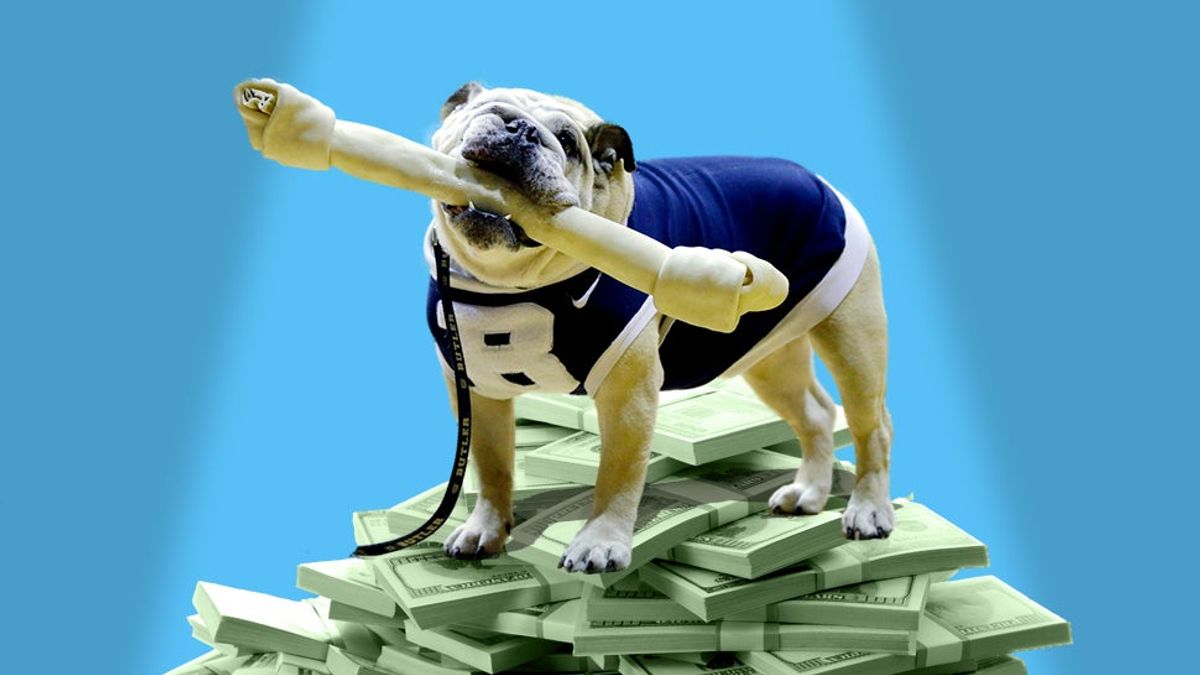
At its core, the mascot is about building a community around a team, or at least insofar as that community drives merchandise revenue. As we saw yesterday, some mascots do this better than others. And some of the most beloved also seem to be the most valuable.
Following our initial look into Native American mascots, we were asked to take a closer look at live animal mascots, since they are somewhat controversial. Like most sports fans, we were only familiar with some of the more spectacular live mascots such as Bevo, Uga and Ralphie, and had no idea they were a point of contention. In hindsight, it does make sense that animal rights activists would be concerned about the welfare of these living symbols ( which are, admittedly, adorable). So we thought it was worth taking a look. And it turns out, they appear to be more profitable than we could have imagined.
We used publicly available data on college football team revenues for this study, and decided to restrict the analysis to football because many of the most notable animal mascots only appear during the football season (with apologies to Blue). But we should note that we do not know if Colorado has ever run Ralphie the buffalo across the basketball floor.
For this analysis, we used relative revenue as our dependent variable. This was computed by dividing each team's self-reported football revenues by the overall average for each season. Relative revenue was modeled as a function of AQ (automatic qualifying conference) status, winning percentage, level of bowl game participation, local population and student body size. We included a dummy variable for a "live mascot" and an interaction variable between AQ status and having a live mascot. The interaction is included to account for the possibility that live mascot effectiveness varies across level of competition.
| Mascot Type | Estimate | Standard Error | t-Value | Pr>|t| |
| Live Mascot | 0.018 | 0.072 | 0.25 | 0.1015 |
| Live Mascot*AQ | 0.369 | 0.086 | 4.28 | <.0001 |
So let's translate these coefficients into dollars. (Remember that the statistical results were generated using relative revenues.) In 2010, average revenues across the FBS schools were about $23 million, and about $35 million for members of the AQ conferences. The model therefore suggests that while the net effect for a non-AQ school is negligible, on average, an AQ member school with a live animal mascot generates about $8.5 million in incremental revenue!
This is an amazing number, but it does have some logic, as live animals may be exceptional community builders, helped along in the case of the AQ schools by an economy of scale and exposure. In the case of mascots like Reveille or UGA it is almost as if the entire student body and alumni base co-owns a dog, whereas few students at St. John's have even conceptualized what a "Red Storm" would look like. And in the case of Bevo or Ralphie, it is hard to imagine a more spectacular halftime display. (These shows featuring large animals are especially entertaining, it might be assumed, by large groups of intoxicated undergraduates.)
While it might be argued that this causation comes from schools with already-high revenue being able to afford a live mascot and all the care that it entails, we believe by separating out AQ conference teams we help alleviate this concern, but would be open to a closer examination.
These results highlight the tough battle that PETA and other animal rights organizations fight. Unlike the Native American mascots, the data suggest that live mascots drive incremental revenue and brand equity, which itself is possibly because they are beloved to a degree that other mascots are not.
Leave any comments or criticisms in the discussion below.
Mike Lewis is an Associate Professor of Marketing at Goizueta Business School, Emory University
Manish Tripathi is an Assistant Professor of Marketing at Goizueta Business School, Emory University
The Emory Sports Marketing Analytics website provides an outlet for research on how sports entities (Leagues, Teams, & Players) create and maintain valuable marketing assets. You can find them on Twitter @sportsmktprof.
Top image by Sam Woolley
Related
The 5-0 49ers Are Finally Getting the Respect They Deserve
Jorge Masvidal Makes $100K Pick to Beat Islam Makhachev
Dana White's Contender Series Week 10 Predictions and Picks
Guardians vs. Rays Prediction: Picks, Odds for ALCS Game 1
- Three Longshot NFL Futures Worth Betting in Week 5
- Falcons vs. Ravens Odds, Prediction and Best Bet for Sunday Night Football
- White Sox vs. Guardians ALDS Game 5 Betting Pick
- UFC Vegas 122 Betting Odds: The Biggest Line Moves Before Allen vs. Duncan
- UFC Vegas 122 Picks and Predictions: Three Bets for Allen vs. Duncan
- College Football Week 6 Bets: Three Picks for Saturday’s Biggest Games
- UFC Fight Night Underdog Pick: Why Kai Kamaka III Is Worth a Bet